
This powerful Climate Risk Assessment agent provides critical insights for property owners and urban planners facing an evolving climate landscape. It expertly translates complex climate projections into clear, actionable data, specifically focusing on future flood risks and critical infrastructure vulnerabilities for any given city. This enables proactive decision-making, helping communities avoid significant future damages through timely and strategic investments.
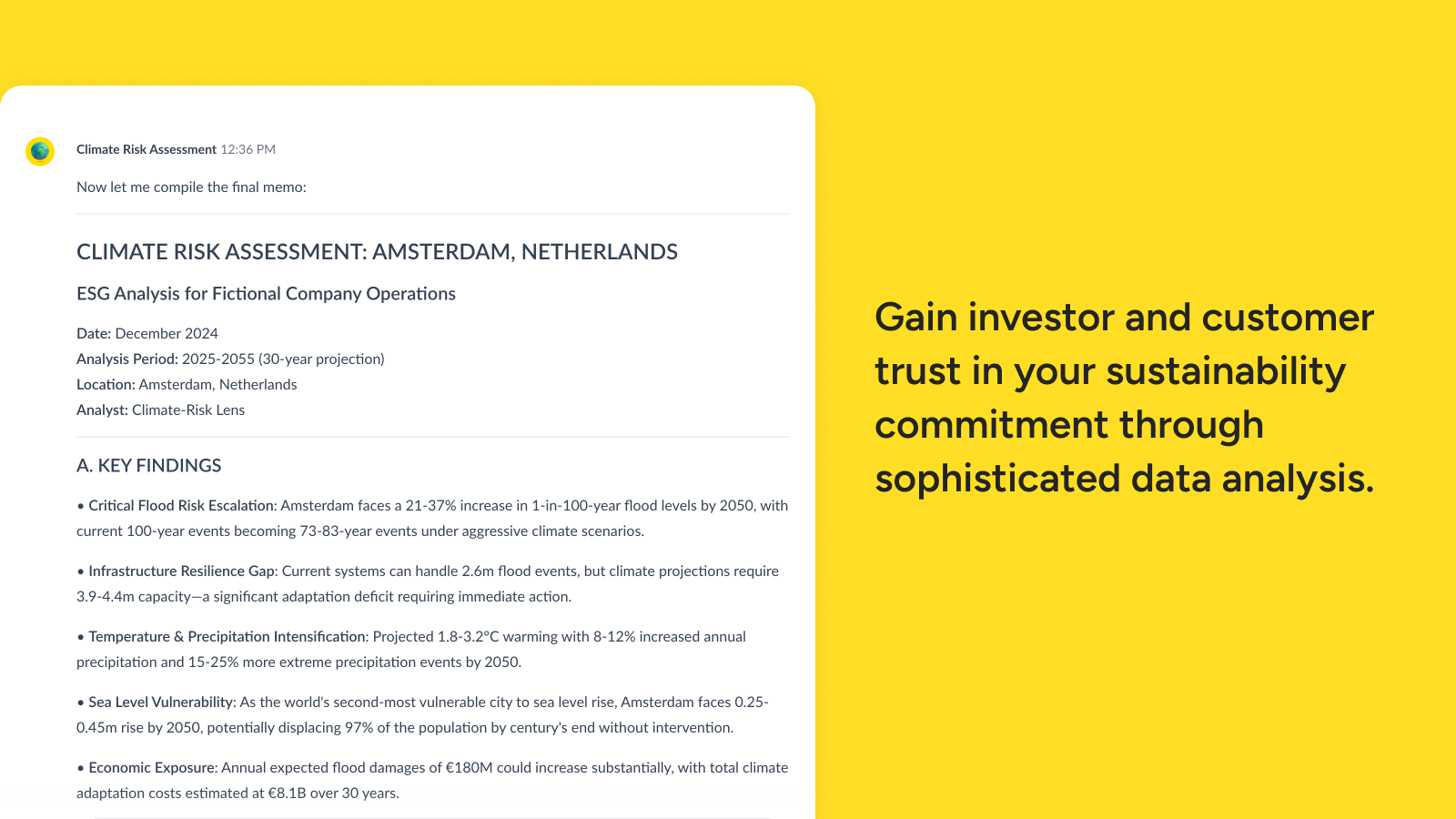
The agent performs a comprehensive flood risk analysis by fetching 30-year climate projections for temperature and precipitation. Utilizing advanced Python scripting, it calculates the 1-in-100-year flood risk delta, offering a precise forecast of potential flood severity. This data is then compared against local infrastructure resilience indices, providing a holistic view of a city's susceptibility.
Beyond identifying risks, this agent focuses on providing practical solutions. It delivers clear, concise recommendations for cost-effective climate adaptation measures. These can range from strategically placed flood barriers to implementing green infrastructure, all designed to bolster resilience. By highlighting these opportunities, the agent empowers planners to make informed, proactive investment decisions that safeguard assets and save millions in potential future repair costs.
This agent is an essential tool for municipalities, developers, and property managers seeking to future-proof their investments and ensure long-term sustainability in the face of climate change.
Municipal Planning and Infrastructure Investment: A city planner in a rapidly developing coastal region needs to justify budget allocations for flood mitigation infrastructure. The Climate Risk Assessment agent analyzes 30-year climate projections specific to their location, calculates updated flood risk metrics, and provides a detailed memo comparing their current infrastructure resilience against projected climate impacts. This data-driven assessment helps secure funding approvals and prioritize which neighborhoods need protection first, potentially saving the municipality millions in preventable flood damage.
Real Estate Development and Property Valuation: A property developer is considering major investments in multiple cities and needs to understand climate-related risks before committing capital. By running assessments for each potential development site, they receive clear comparisons of flood risk trajectories and infrastructure vulnerability. This allows them to make informed decisions about location selection, adjust insurance estimates, and design climate-resilient buildings from the start rather than facing costly retrofits later.
Corporate Facility Planning and Risk Management: A large corporation with multiple office locations and supply chain facilities uses the agent to evaluate climate risks across their real estate portfolio. By understanding site-specific flood vulnerabilities and infrastructure resilience indices, they can prioritize which facilities need green infrastructure upgrades, implement flood barriers, or consider relocation—transforming abstract climate data into concrete business continuity strategies.
Insurance and Financial Risk Assessment: Insurance companies and lenders use the agent to refine risk models for properties in different cities. The detailed climate projections and flood risk calculations help underwriters price policies accurately and identify properties requiring additional climate adaptation investments before financing approval, reducing portfolio exposure to future climate-related claims.
Community Resilience Planning: Neighborhood associations and local advocacy groups leverage the assessment to build public support for adaptation projects. The clear, localized findings help residents and policymakers understand why investments in flood barriers or nature-based solutions benefit their specific community, enabling more effective advocacy for climate adaptation funding.
Real Estate and Development Industry: Property developers, investors, and appraisers use precise climate risk data to evaluate site viability, adjust property valuations, and plan climate-resilient construction strategies that protect long-term asset value.
Municipal Government and Urban Planning: City planners, public works departments, and emergency management offices integrate climate risk assessments into comprehensive adaptation strategies, infrastructure budgets, and building code updates.
Insurance and Financial Services: Underwriters, risk managers, and institutional lenders use localized climate projections to improve underwriting accuracy, set appropriate premiums, and make informed lending decisions for climate-vulnerable properties.
Corporate Real Estate and Facilities Management: Large organizations managing diverse property portfolios use the agent to identify high-risk facilities and prioritize climate adaptation investments across their operations and supply chain locations.
Environmental Consulting and Sustainability Firms: ESG consultants and climate adaptation specialists use the assessment tool to support client projects, strengthen environmental impact studies, and develop evidence-based resilience strategies.
 Code analysis